
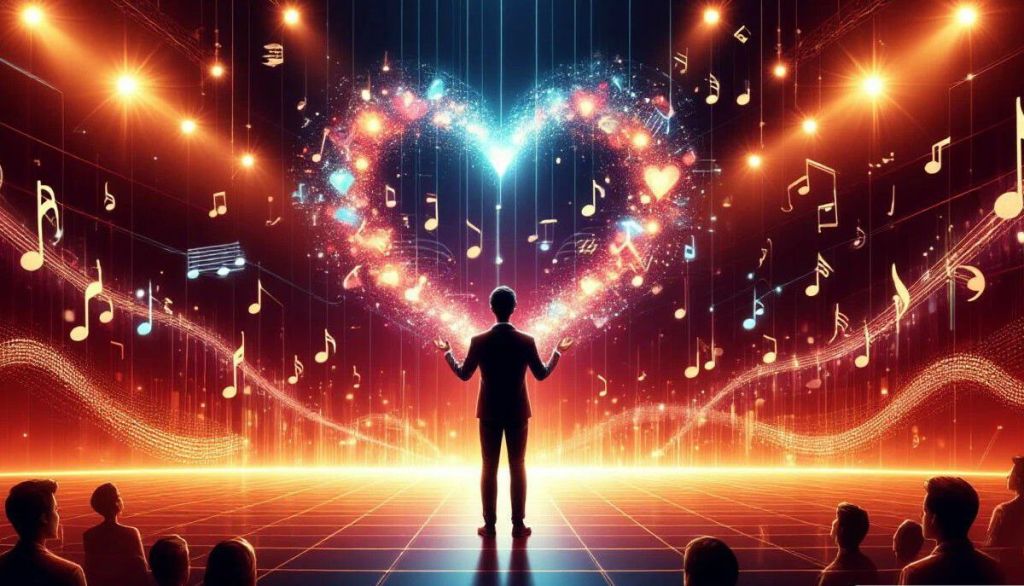
In 2025, music has become more digital than ever. Algorithms predict what we’ll like before we even hear it. Virtual stages host thousands of avatars jumping to the same beat. Artificial intelligence can now compose songs that sound eerily human.
And yet, amid all the innovation, one question feels louder than ever:
Can technology really replace the human soul behind the sound?
When music became a mirror of our screens
Music used to live in sweaty clubs, echoing stadiums, and crowded bars — places filled with voices, laughter, and real energy. Now, much of that energy flows through screens. We scroll, we stream, we listen alone, often with headphones that isolate us from the world.
Virtual events have tried to bridge that gap — offering incredible visuals, digital stages, and shared experiences inside virtual spaces. As explored in “Virtual Concerts and Metaverse Stages: The New Era of Live Music”, the metaverse brought people together across continents, redefining what “live” performance means.
But no matter how breathtaking the holograms are, they still lack one thing: the raw, imperfect pulse of real connection.
The irreplaceable heartbeat of live emotion
What makes music so powerful isn’t just sound — it’s shared emotion.
The spark when an artist locks eyes with the crowd. The collective shout of a chorus sung in unison. The goosebumps when a song speaks directly to what you’re feeling.
Technology can simulate almost everything, but it struggles to replicate authentic empathy. A virtual stage can stream light and motion, but not the electricity of presence — that invisible thread between performer and listener that makes every note alive.
Digital tools, human purpose
Of course, it’s not about rejecting progress. The digital age has opened doors that were once unimaginable. Artists today have direct access to global audiences; independent creators thrive without record labels. Data helps us understand trends, while artificial intelligence helps craft new sounds and textures.
This evolution has reshaped music itself. As discussed in “Music in 2025: The Sounds, Trends, and Hits That Defined the Year”, the sonic landscape of this decade is more experimental, inclusive, and global than ever before.
But the tools are only half the story. The real challenge is not how we use technology — but why we use it. Are we creating music to generate clicks, or to generate feelings?
The new emotional frontier
The future of music isn’t about choosing between digital and human. It’s about weaving them together. Imagine AI-assisted composition guided by genuine emotion; virtual stages that amplify, not replace, human presence; soundscapes that react to real-time audience moods.
The artists who will define the next decade are those who understand that emotion is the ultimate innovation.
People don’t remember perfect mixes — they remember how a song made them feel during a turning point in their lives.
From connection to community
More than ever, music is becoming a form of emotional communication.
Playlists are personal diaries. Online fandoms become support systems. A single song can unite strangers across borders.
That’s the paradox of digital culture: while it often separates us, it also gives us new ways to connect — deeply, instantly, and authentically.
Maybe the true future of music isn’t found in the next algorithm or virtual platform, but in the human stories behind the headphones.
Final note
As we look ahead, one truth remains timeless:
Music is emotion in motion.
Technology will continue to evolve, but the heartbeat of music — that fragile, beautiful connection between creator and listener — will always belong to humans.
Because no matter how perfect the code, nothing sounds more alive than a feeling that’s real.
 Tinytunes.app