
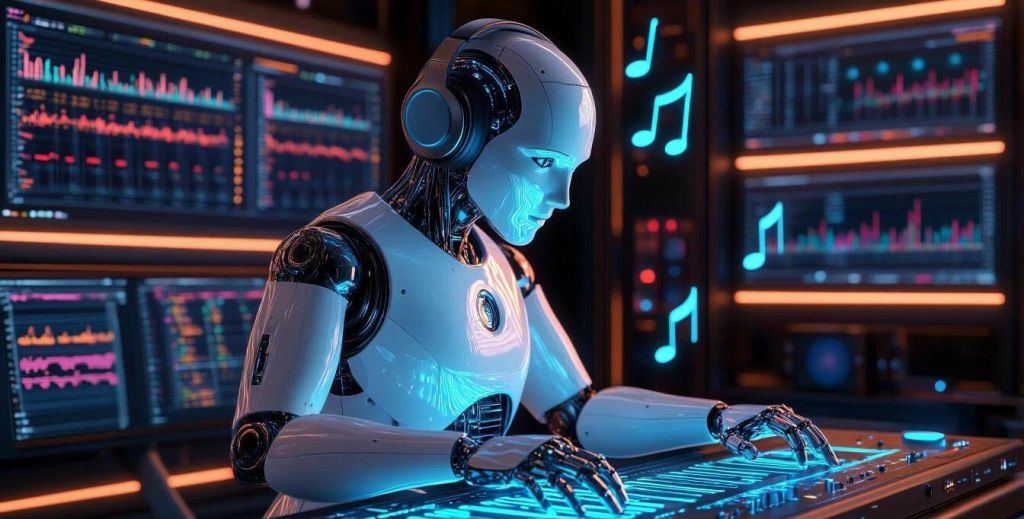
Artificial intelligence has already shaken the foundations of the music industry. From composing melodies to cloning human voices, AI is no longer a tool — it’s becoming a creator.
But as the line between human and machine artistry blurs, one question keeps growing louder: who truly owns creativity when a song is born from code, not emotion?
🎤 When Machines Start to Sing
Just a few years ago, the idea of a computer writing a hit song sounded futuristic — almost absurd. Today, AI musicians are releasing tracks that make it to Spotify playlists and even viral TikTok trends.
We’re witnessing the rise of fully synthetic performers, trained on thousands of human songs to mimic style, rhythm, and emotional tone.
In fact, some of the first “AI artists” are already making headlines — as explored in AI Musicians: Will the Next Superstar Be a Machine?.
It’s exciting, yes — but it also opens Pandora’s box of ethical dilemmas.
🧠 The Deepfake Dilemma: When Voices Aren’t Real
One of the most controversial uses of AI in music is voice cloning. Neural networks can now reproduce a singer’s tone, accent, and even emotional nuances so precisely that most listeners can’t tell the difference.
While this technology can revive lost voices or create virtual duets between living and deceased artists, it’s also being misused. “Deepfake songs” — AI tracks that mimic famous singers without consent — are spreading fast.
For example, AI-generated tracks imitating Drake or The Weeknd have gone viral, raising questions like:
• Who owns the rights to a cloned voice?
• Can an artist copyright their vocal identity?
• And what happens when fans can’t distinguish between the real and the artificial?
These are not just technical questions — they cut to the core of artistic integrity.
⚖️ Who Owns an AI-Created Song?
In traditional copyright law, ownership is granted to the creator. But what happens when the “creator” is an algorithm trained on millions of existing songs?
If an AI learns from the works of Beethoven, Beyoncé, and Billie Eilish, and then writes a melody — does it belong to the programmer, the dataset, or the machine itself?
Currently, most legal systems agree that only humans can hold copyright. However, this view is being challenged as AI-generated works become indistinguishable from human ones.
The debate is particularly intense in the music industry, where style imitation has always been part of the art — but AI takes it to another level.
For a broader perspective on how artificial intelligence is transforming the creative process, check out From Studio to Stage: How AI Is Transforming Music Production and Performance.
AI isn’t just helping artists; it’s starting to become one.
💡 Ethics vs. Innovation: A Balancing Act
Ethics often lags behind technology. While AI gives musicians powerful creative tools, it also blurs moral boundaries. Imagine a young producer using an AI model trained on thousands of existing songs — is it innovation or plagiarism?
Music companies are beginning to respond. Some streaming platforms have already removed AI-generated tracks that mimic artists without consent. Others, like Universal Music Group, are pushing for new frameworks to protect human talent.
Meanwhile, AI developers argue that creativity should be shared — that these tools democratize music production by giving everyone access to infinite inspiration.
It’s a fine balance: preserving authenticity while embracing progress.
🎧 Collaboration or Competition?
Many artists are choosing collaboration over confrontation. They use AI to enhance their music — from generating harmonies to mixing tracks — without giving up authorship.
In this way, AI becomes an assistant rather than a rival.
This hybrid model is already producing some fascinating results.
As explored in the follow-up article [AI Musicians: Will the Next Superstar Be a Machine? Part II, artists who embrace AI often find new forms of expression they never imagined before.
The future may not be “humans versus machines,” but humans with machines — working together to push creativity beyond its current limits.
🪶 Can Machines Feel?
Perhaps the biggest philosophical question is whether AI can ever truly *feel* what it creates.
Music is not just sound — it’s emotion, memory, and lived experience. While AI can analyze patterns and simulate sadness or joy, it doesn’t experience them.
So even if an AI song sounds perfect, it might still lack the invisible thread of humanity — the vulnerability, imperfection, and soul that makes music universal.
🌍 The Road Ahead: Redefining Creativity
We are standing at a historic crossroads.
AI-generated music challenges our understanding of authorship, ethics, and even what it means to be creative. But rather than fearing it, the industry has an opportunity to redefine those concepts.
What if future copyright laws include “AI collaboration credits”?
What if artists start licensing their voiceprints like samples?
And what if we start valuing not only who made the song, but how it was made?
The conversation is only beginning — and every track released by an algorithm is another verse in that global debate.
🎵 Final Note
Whether you see AI as a threat or a muse, one thing is clear: music will never be the same again.
As technology continues to evolve, so will our definition of creativity — and perhaps that’s the most human thing about it.
 Tinytunes.app