
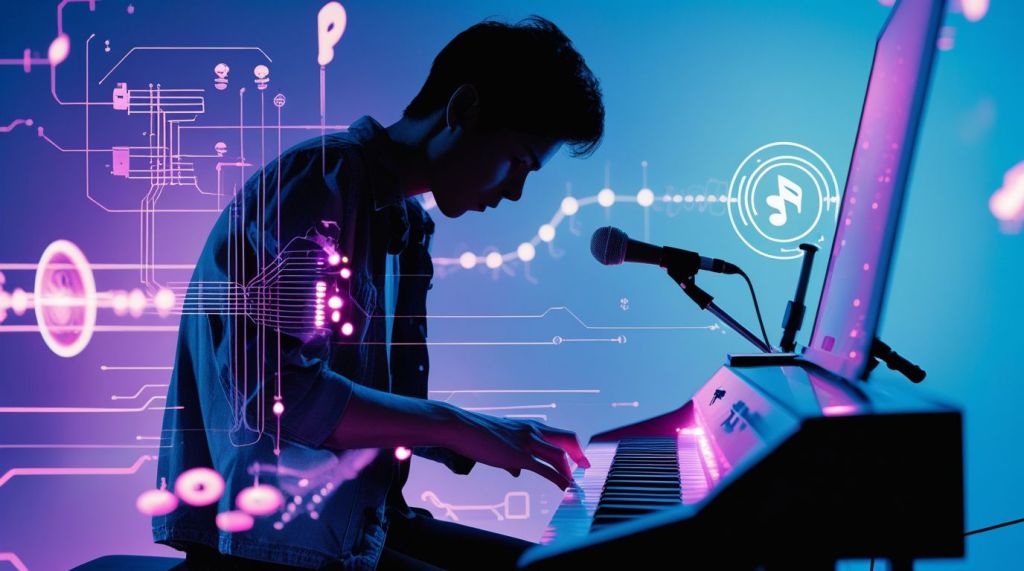
The music industry is entering an era where creativity is no longer limited to traditional instruments or human imagination alone. Artificial Intelligence is not here to replace musicians but to become their co-creator, offering fresh perspectives, tools, and inspiration. When used wisely, AI can help artists unlock new ideas, refine their workflow, and even reach audiences faster than ever before.
If you’ve already explored AI music apps and services, or learned about how AI supports creativity without replacing it, you’ll see that the key is not “AI vs. human,” but “AI + human.” Let’s dive into how this collaboration can bring music to life.
Approaches to Human + AI Collaboration
1. Idea Generation
AI can quickly suggest melodies, chord progressions, or rhythmic patterns. Instead of staring at a blank page, musicians can start with an AI-generated seed and then shape it into something unique. The human touch adds depth, storytelling, and emotion that algorithms cannot replicate.
2. Co-Editing and Refinement
Musicians can record a rough sketch and then use AI tools to polish it—adjusting timing, suggesting harmonies, or balancing the mix. This approach saves hours of technical work and leaves more room for artistry.
3. Experimentation Across Genres
Curious how your acoustic ballad would sound with a lo-fi beat or cinematic strings? AI can help simulate cross-genre variations in seconds. While some will be discarded, others may open creative doors you hadn’t considered.
4. Personalized Practice and Learning
Beyond composition, AI can act as a practice partner. It can generate backing tracks at different tempos or styles, making rehearsals more dynamic and motivating.
Mini-Tips for Beginners
Getting started with AI in music doesn’t have to be overwhelming. Here are a few prompts and practices to explore:
• For melody generation: Try asking an AI tool, “Create a 4-bar melody in a jazzy style with a smooth flow.” Even if you don’t love the result, it can spark new directions.
• For lyric ideas: Use prompts like, “Suggest chorus lines about hope after a storm in an indie-folk mood.” Refine them with your own voice and storytelling.
• For editing: Feed your draft into AI mixing assistants with clear instructions, such as, *“Balance vocals to be warmer and slightly louder than the instruments.”*
• For inspiration: Ask AI to reimagine your track in another genre—sometimes an unexpected version reveals the strongest hook.
Remember: prompts don’t need to be perfect. They are simply starting points that you refine with your artistry.
Why This Partnership Matters
AI is best seen as a collaborator that brings efficiency and experimentation, while humans bring authenticity, emotion, and context. The most powerful music will always come from lived experiences and personal expression—but technology can help capture those feelings more effectively.
Musicians who embrace AI as a partner are not losing their identity. They are expanding their toolkit. Just as synthesizers once transformed the sound of the 1980s, AI is shaping the sound of the 2020s and beyond. The real art lies in blending technology with humanity to create music that feels alive.
Final thought: Music has always evolved through new tools, from electric guitars to digital audio workstations. AI is simply the next instrument—one that learns, adapts, and collaborates. The question is not whether it will replace musicians, but how musicians will use it to create something truly original.
 Tinytunes.app