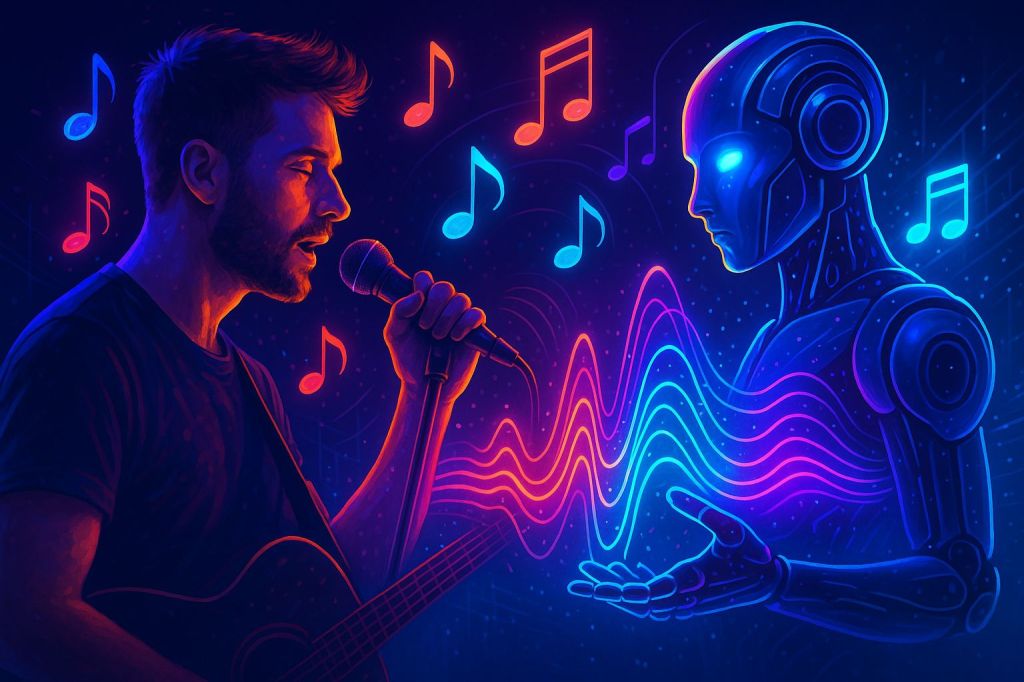
AI can write songs, paint portraits, and even crack jokes — but is it truly creative, or just a clever copycat?
🎨 A New Era of Creative Machines
The rise of artificial intelligence in creative fields has stirred a lot of buzz — and even more fear. From musicians to designers, many ask the same burning question:
> “If AI can create art, what’s left for humans?”
With tools like ChatGPT generating song lyrics and platforms like Suno composing full audio tracks, it might feel like machines are stepping onto the creative stage — front and center.
But before we panic and cancel all art schools, let’s take a closer look at what AI can actually do, what it can’t, and why human creativity is far from obsolete.
🤖 AI Art Isn’t New — Just Faster
The idea of machines making music or visuals isn’t brand-new. Early algorithmic art existed in the 1960s. But what’s changed is accessibility and quality.
Today, anyone with a browser can:
• Write a song using GPT-4
• Generate full music tracks with AI voices
• Create digital paintings or logos in seconds
• Animate videos without touching editing software
And it works. Some AI-generated songs go viral, and AI-generated art wins awards. But does that mean creativity is at risk?
🎼 The Music Debate: Can a Machine Feel?
Let’s take music as an example. AI tools today can not only write lyrics but also produce complete songs. We explored this in detail in our recent articles:
👉 AI Songwriter: Can Robots Create a Hit?
👉 Chatbots That Compose: Using GPT to Generate Lyrics
These articles dive deep into how AI models, like GPT and Boomy, craft melodies, lyrics, and moods on command.
But here’s the catch: AI doesn’t feel.
It doesn’t get its heart broken. It doesn’t fall in love. It doesn’t struggle to express itself at 3AM through a messy song draft.
It predicts patterns. And that’s different from living the emotion.
🧠 The Myth of “Fully Automated Creativity”
A common misconception is that AI is replacing artists. In reality, AI is more like a power tool than a replacement.
Think of it this way:

The best results often come from collaboration. Human sets the vision — AI fills in the details.
✍️ AI as a Creative Sidekick
Here’s how creators are actually using AI:
• Musicians use it for overcoming writer’s block
• Designers generate quick drafts or mood boards
• Writers explore character dialogue or plot twists
• Filmmakers create storyboards or sample scores
Rather than replacing human creativity, AI is becoming a creative partner — like having a super-speed intern who never sleeps (but maybe lacks a soul).
⚖️ The Ethical Grey Zone
Of course, the rise of creative AI brings questions:
• Who owns AI-generated art?
• Should artists be compensated if their work trained the model?
• What happens if AI mimics your voice or visual style?
The legal and ethical frameworks are still catching up. But more platforms now offer tools with clear licensing and ethical training practices.
Creativity, after all, thrives in fairness — not exploitation.
🎯 Final Thoughts: Creativity Is Evolving, Not Dying
So, is human creativity at risk?
No. It’s changing.
AI can do amazing things — but the spark of a truly moving song, painting, or film still begins with a human heartbeat. Real creativity involves risk, intuition, and meaning — something no algorithm can replicate.
So don’t fear the robots. Collaborate with them. The future of art isn’t about man vs. machine — it’s about man with machine.
 Tinytunes.app