
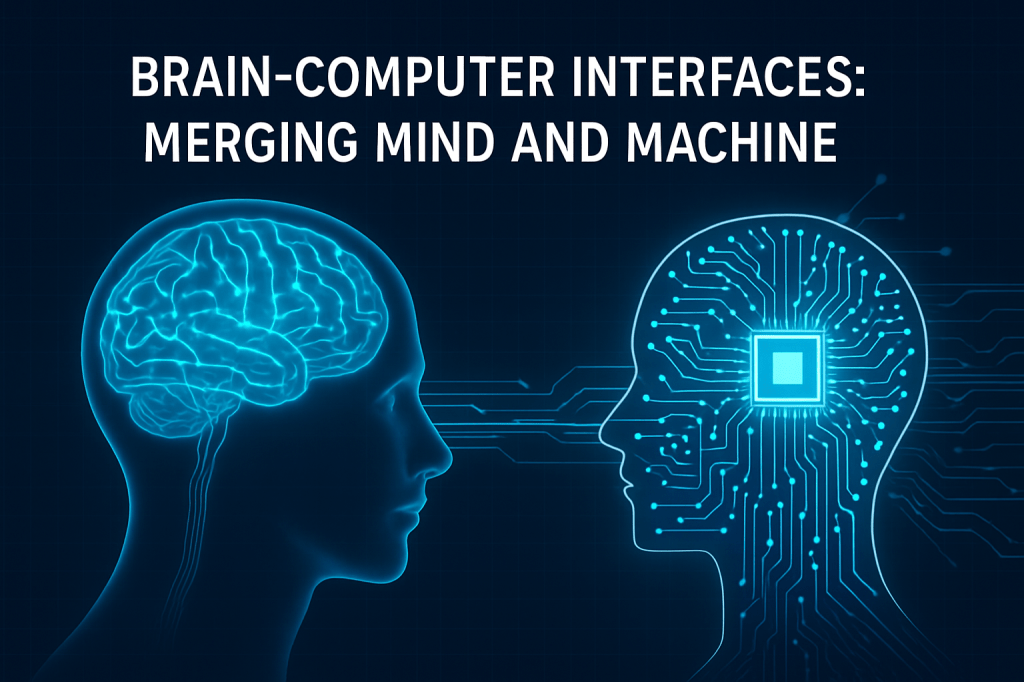
In the age of rapid technological evolution, few innovations feel as profound and potentially transformative as Brain-Computer Interfaces (BCIs). Once the stuff of science fiction, BCIs are now moving closer to becoming everyday reality. These devices, which establish a direct communication pathway between the human brain and external machines, hold the power to revolutionize medicine, communication, and even our understanding of consciousness itself.
What Are Brain-Computer Interfaces?
A Brain-Computer Interface is a system that allows the brain to send and receive information directly to or from a computer or other external device. This can be achieved through various methods, including non-invasive technologies like EEG (electroencephalography), semi-invasive methods such as ECoG (electrocorticography), and fully invasive approaches like implanted electrodes. Regardless of the method, the goal is the same: bypass traditional physical pathways and connect thought to action.
From Thought to Action: How BCIs Work
At the core of every BCI is the ability to detect neural activity. The human brain consists of approximately 86 billion neurons that communicate via electrical impulses. By capturing these impulses, BCIs can interpret patterns that correspond to thoughts, intentions, or motor commands.
For example, in motor BCIs, when a person thinks about moving their arm, specific neurons in the motor cortex fire. BCIs detect these signals, decode them, and translate them into commands that a computer or robotic limb can understand — allowing a paralyzed person to control a prosthetic simply by thinking.
Medical Miracles in the Making
The most immediate and compelling applications of BCIs lie in medicine. For individuals suffering from neurodegenerative diseases like ALS, spinal cord injuries, or strokes, BCIs offer the promise of regained independence.
Several breakthroughs have already occurred:
• Restoring Communication: Projects like Meta’s Speech Neuroprosthesis or Neuralink’s experiments with implanted chips are enabling people who have lost the ability to speak to communicate again — by translating neural signals into text or synthesized speech in real-time.
• Controlling Prosthetics: Companies like BrainGate and DARPA are developing prosthetic limbs that respond to thought, with some patients already able to move robotic arms or hands with surprising accuracy and fluidity.
• Neurorehabilitation: BCIs are also being used to retrain damaged neural pathways, helping stroke victims regain motor function through neurofeedback and guided movement therapy.
Beyond Medicine: Expanding Human Potential
While the medical applications are powerful, the long-term vision of BCIs extends far beyond healthcare.
Imagine typing an email simply by thinking, or controlling your smart home with nothing more than a thought. BCIs could enable direct interaction with digital systems, bypassing keyboards, touchscreens, or voice commands. For creative professionals, it might become possible to draw, compose music, or write code directly from the brain — unlocking new dimensions of productivity and expression.
Some even envision **“neural augmentation,”** where humans enhance their natural cognitive abilities. Could BCIs help us learn languages faster? Improve memory? Merge with AI to become superintelligent hybrids?
The Role of Companies Like Neuralink
Elon Musk’s Neuralink has been one of the most visible champions of BCI technology. The company aims to develop high-bandwidth, minimally invasive BCIs that not only restore lost function but eventually expand human capabilities. In 2024, Neuralink implanted its first chip in a human patient, who reportedly could control a cursor on a screen just by thinking — a monumental step for the field.
Neuralink’s ultimate goal? A future where humans and AI exist in a symbiotic relationship, with BCIs serving as the interface between the biological and the artificial.
Ethical and Philosophical Implications
But with great power comes great responsibility — and BCIs raise serious ethical questions.
• Privacy of Thought: If machines can read our thoughts, who controls that data? How do we protect mental privacy in a world where thoughts could potentially be hacked?
• Consent and Safety: Invasive BCIs involve brain surgery, which carries risks. Even non-invasive systems could affect mental health if misused or over-relied upon.
• Digital Divide: Will BCI technology be accessible to everyone, or only the wealthy and powerful? Could it create a new form of inequality between the “augmented” and the “natural”?
• Identity and Consciousness: If we merge our minds with machines, what happens to our sense of self? At what point does a human enhanced by AI cease to be fully human?
These are not hypothetical concerns. As the technology develops, society will need to develop frameworks — legal, ethical, and cultural — to ensure that BCIs benefit humanity without compromising our values.
The Road Ahead
BCIs are still in their infancy. Current systems are expensive, slow, and often require specialized equipment or surgical procedures. But progress is accelerating. As neural recording becomes more precise, machine learning improves decoding accuracy, and brain implants become safer, the vision of seamless mind-machine integration is becoming increasingly plausible.
In the next decade, we may see the first commercial BCI devices for healthy users, perhaps as brain-enhancing wearables or even smartphone-controlled implants. As they become more common, BCIs could reshape how we work, communicate, learn — and ultimately, how we understand what it means to be human.
Conclusion
Brain-Computer Interfaces are more than just a new technology — they represent a new frontier of human experience. By merging mind and machine, BCIs challenge the boundaries between biology and technology, reality and imagination. Whether used to restore lost abilities or unlock entirely new ones, BCIs have the potential to redefine our relationship with ourselves, with each other, and with the digital world.
The future is not just about smarter machines — it’s about smarter, more connected humans.
 Tinytunes.app